Scientific Poster
>
High Throughput Assay to Screen for Inhibitors of the Proto-Oncogene Stat3
High Throughput Assay to Screen for Inhibitors of the Proto-Oncogene Stat3
Download ↓
1. Abstract
The latent transcription factor Stat3 (signal transduction and activator of transcription) has been implicated in contributing to neoplasia because it is aberrantly activated in numerous tumors and tumor-derived cells and is widely regarded as a key target for therapeutic intervention. Upon phosphorylation on a single tyrosine residue (Y705), the Stat3 protein forms dimers via mutual SH2 domain/pY705 interactions, a requisite step for nuclear translocation, DNA binding and transcriptional activation.We have developed an assay that mimics the interaction between the Stat3 SH2 domain and pY705 using immobilized protein decorated with a phosphopeptide encompassing this tyrosine residue and recombinant Stat3 protein. The assay is robust (signal to background values >8) and reliable (Z'=0.6) and binding constants on the order of 157nM have been obtained. It is being employed to identify small molecules that interfere with Stat3 dimerization which may hold promise as cancer therapeutic agents.
 View More
 View Less
2. MSD MULTI-ARRAY and MULTI-SPOT Plates
Instrument Features
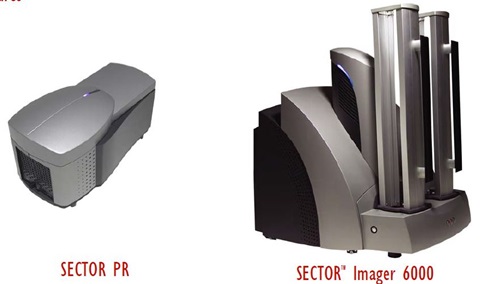
- Highly sensitive imaging detection systems
- Single and multiplex plate formats
- SECTOR 6000 instrument designed for high-throughput screening (HTS)
- Rapid read times
- SECTOR 6000 or SECTOR PR instruments ideal for assay development
- Electrochemiluminescent (ECL) technology

Plate Features
- Disposable Plates
- Carbon Electrodes with high binding capacity
- Suitable electrochemistry for ECL
- A variety of surface treatments, array preparations and coatings are available
3. Electrochemiluminescence (ECL)

4. Stat3 Proteins

- Src homology 2 (SH-2) containing transcription factor.
- Activated by phosphorylation on a single tyrosine (Y).
- Form dimers via SH-2/phosphotyrosine interaction and rapidly translocate to the nucleus.
- Transcriptional activity can be augmented by serine phosphorylation (S).
- Constitutively activated Stat3 in tumors increases the proliferative capacity of cells (increased c-myc message and protein) and decreases apoptosis (increased expression of the anti-apoptotic gene bcl-XL).
5. Mechanisms of Stat3 Activation

6. Depiction of the Stat3-SH2/phosphotyrosine Binding Assay

Schematic representation of Stat3 SH2/domain interaction assay. A. Shows the binding of dimer-incompetent recombinant Stat3 to immobilized BSA that has been decorated with a phosphopeptide encompassing tyrosine 705 of Stat3. B. Shows the representative binding of sTAG-labeled Stat3 to the immobilized BSA peptide conjugates (Left, pY705; Right,Y705).
7. Binding of Stat3 to Stat3-Derived Phosphopeptide

BSA-coupled phosphopeptides were deposited onto the surface of a 384-well MULTI-ARRAY plate. MSD SULFO-TAG-labeled recombinant, dimer-incompetent Stat3 protein was then added to the wells at the concentrations indicated. The plate was incubated at room temperature for 4 h, washed and MSD Read Buffer added. It was then imaged on the SECTOR Imager 6000 reader.
8. Assay Stability in Read Buffer
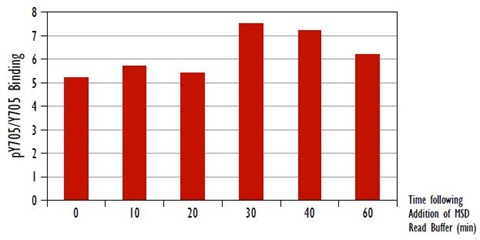
MSD-SULFO-TAG-labeled recombinant Stat3 protein (150nM) was added to the well of a 384-well MULTI-ARRAY plate in 1x Binding buffer. The plate was then incubated at room temperature for 4h. MSD Read Buffer added and the plates were imaged on the SECTOR Imager 6000 reader at the times indicated above. The ratio of Stat3 binding to the phospho- and non-phospho-peptide are indicated.
9. DMSO Compatibility
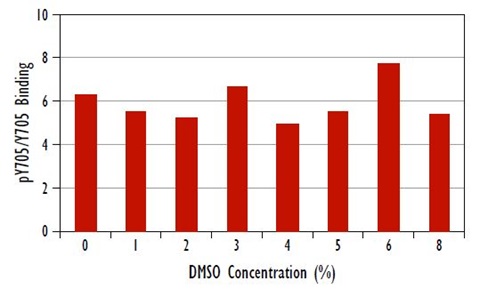
MSD-SULFO-TAG-labeled recombinant Stat3 protein (150nM) was added to the well of a 384-well MULTI-ARRAY plate in 1x Binding buffer containing DMSO at the concentrations indicated. The plate was incubated at room temperature for 4h, MSD Read Buffer added and imaged on the SECTOR Imager 6000 reader. The ratio of Stat3 binding to the phospho- and non-phospho-peptide are indicated.
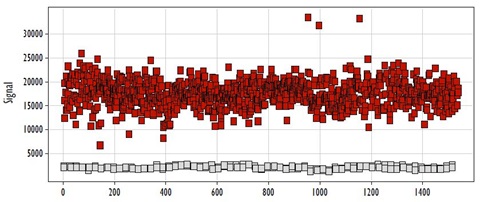
10. HTS Capabilities of Stat3/Phosphopeptide Assay
Homogeneous Assay Workflow
- MULTI-ARRAY plates were printed with BSA-coupled phosphopeptides (or control peptide)
- Incubate with MSD SULFO-TAG-labeled recombinant, dimer-incompetent Stat3 and incubated at room temperature for 4 hr (Inhibitors could be added at this step)
- The plates were then imaged on the SECTOR Imager 6000 reader
Gray squares indicate binding to the non-phosphorylated Stat3 peptide; Red Squares indicate binding to pY705.
Signal/background values of 8 and a Z' score of 0.6 indicate that the Stat3/Phosphpeptide assay is amenable for use in high throughput screening efforts.
11. Conclusions
-
Stat3 is constitutively activated in numerous types of cancers making it an important target for therapeutic intervention.
-
We describe an assay that assesses the interaction between the Stat3 SH2 domain and tyrosine 705 that mimics Stat3 dimerization, the key point in activation of the molecule.
-
The assay is robust, DMSO-tolerant, stable in Read Buffer making it amenable to high throughput screening.
-
It is being employed to screen for small molecules that interfere with the formation of Stat3 dimers.
-
These lead compounds could be used to block the function of Stat3 in tumors in which it is aberrantly activated.
Customer Service/Orders
Technical Support
Company Headquarters