2. Introduction
Neurodegeneration:
- Many disorders involving neurodegeneration, including Alzheimer’s disease (AD), Parkinson’s disease (PD), frontotemporal dementia (FTD), amyotrophic lateral sclerosis (ALS), and traumatic brain injury (TBI), lack disease-modifying treatments.
- Gaining a better understanding of the mechanisms underlying these conditions will aid in researching targeted treatments.
Inflammation in neurodegeneration:
- Although the profile of inflammatory markers during the prodromal and symptomatic phases of these conditions has been a topic of interest to many researchers, results remain mixed.
- IL-6 and TNF-α are commonly reported to be increased in conditions including AD and TBI; however, other studies show reductions or a lack of response. Data on other inflammatory markers show a lack of consensus. More work is needed to understand the correlation between inflammatory markers and neurodegeneration.
- It has been suggested that specific mutation types, treatments (notably, acetylcholinesterase inhibitors), and the course of the disorder may all impact the specific inflammatory profiles, and should be considered separately.
- Longitudinal studies will best identify inflammatory profiles leading up to, and during, the course of neurodegenerative disorders and conditions.
Increasing the sensitivity of our current V-PLEX® proinflammatory assay:
- A limitation in using mouse models is the small amount of blood that can be collected at a single timepoint. Therefore, laboratories often must circumvent this issue by including separate groups of animals in their studies for each timepoint of interest.
- We aim to make it possible to collect blood at multiple timepoints in the same animals by reducing the sample volume required to detect ten inflammatory markers.
- In this study, we report an average of a 19-fold increase in sensitivity of our validated MSD V-PLEX Mouse Proinflammatory Panel 1 by applying our ultrasensitive S-PLEX® technology.
- By increasing the sensitivity of our assays, and thus lowering the limits of detection, we reduce the volume of sample required to detect these analytes by 8-fold or more.
3. Materials and Methods
Samples:
Commercially sourced aged Alzheimer's disease (AD) plasma samples from 6-month-old female mice were collected from two lines: line 16347 (ARTE10), which harbors mutations in both amyloid β precursor protein and Presenilin 1; and line 1349 (APPSWE), which harbors a mutation in amyloid β precursor protein only. Plasma samples from commercially sourced frontotemporal dementia/amyotrophic lateral sclerosis (line 012836, male 8-week-old mice hemizygous for humanized TDP-43 in neurons under the Thy1 promotor) and AD (line 134711, male 10-week-old mice expressing humanized amyloid β) were obtained. Control plasma samples were pooled EDTA plasma from C57BL/6 mice.
MSD® Assays:
V-PLEX Proinflammatory Panel 1 (Mouse) -
The V-PLEX Proinflammatory Panel 1 Mouse Kit (cat #K15048D) was performed following the standard protocol. Samples were diluted 2-fold with Diluent 41, then serially diluted 4-fold to a final dilution of 512-fold.
S-PLEX with Mouse Proinflammatory Markers -
Experimental plates were coated to match the V-PLEX Proinflammatory Panel 1 Mouse Kit analyte spot layout. Samples were diluted 2-fold, then serially diluted 4-fold to a final dilution of 512-fold. The standard S-PLEX protocol was followed.
S-PLEX Neurology Panel 1 -
The S-PLEX Neurology Panel 1 kit (cat #K15639S) was used to measure GFAP, Neurofilament L, and total Tau. The standard S-PLEX Neurology Panel 1 protocol was followed.
4. MSD Multiplexing Technology
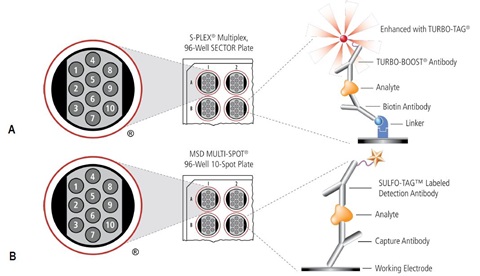
Figure 1. Schematics of MSD technology. A. Schematic of MSD S-PLEX technology, as applied here to the ten analytes provided on the V-PLEX panel above. The S-PLEX specific TURBO-BOOST® antibodies, followed by enhancement of the TURBO-BOOST signal, allow for increased sensitivity and a reduced lower limit of detection of analytes. B. Schematic of the MSD V-PLEX Mouse Proinflammatory 1 Panel. Plates are precoated with ten unique antibodies assigned to one of ten spots in each well. Samples are incubated on the plate to allow antibodies to capture the analytes of interest. A blend of SULFO-TAG™ antibodies is then applied to detect and measure analytes.
5. Results
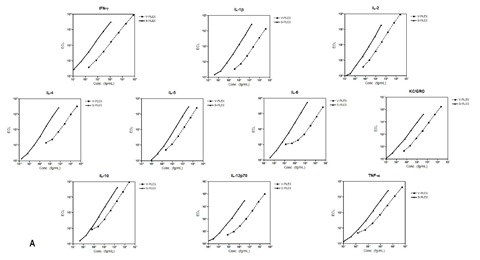
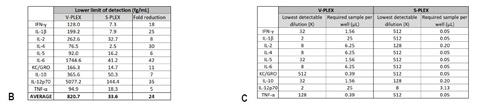
Figure 2. Applying S-PLEX technology to the analytes of the V-PLEX Mouse Proinflammatory Panel 1 increases sensitivity and a reduces the lower limit of detection for all ten analytes. A. Standard calibrator curves for V-PLEX and S-PLEX show the increased sensitivity of the S-PLEX platform. B. The lower limit of detection is reduced an average of 24-fold by using S-PLEX. C. Samples were tested at five dilutions on each platform: 2X, 8X, 32X, 128X, and 512X. The lowest dilution detectable on each platform is shown here, as well as the volume of sample required at each corresponding dilution.
6. Results
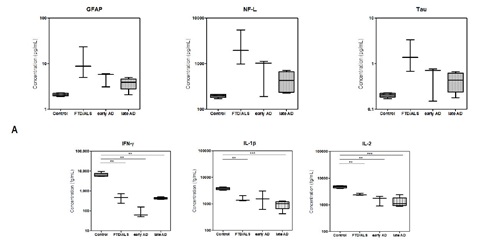
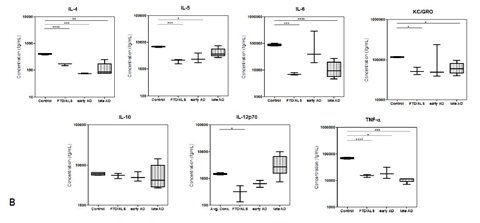
Figure 3. Commercially sourced plasma samples from healthy control mice, as well as models of frontotemporal dementia (FTD)/amyotrophic lateral sclerosis (ALS) at 8 weeks and Alzheimer’s disease (AD) at 10 weeks (early AD) and 6 months (late AD) were tested using V-PLEX and S-PLEX protocols. A. S-PLEX Neurology Panel 1 shows levels of glial fibrillary acidic protein (GFAP), neurofilament light chain (NF-L), and total tau in mouse models. B. S-PLEX testing of ten proinflammatory markers shows changes by mouse model. Statistics: unpaired two-tail t-test with Welch’s correction, n = 3-4 per group, *p < 0.05, **p < 0.01, ***p < 0.001, ****p < 0.0001.
7. Discussion/Conclusions
By reducing the sample volume needed to detect ten proinflammatory markers, we provide a tool that can support possible repeated measures during longitudinal studies of mouse models of neurodegeneration. This can provide valuable insight into the prodromal phases of neurodegenerative diseases.
The National Institutes of Health’s Office of Animal Care and Use states that for a survival blood collection, 1% of a mouse’s calculated blood volume (CBV) can be collected every 24 hours, and 7.5% of the CBV can be collected over a 7-day period. For a 25 g animal, this would equate to 11-14 µL every 24 hours or 90-105 µL per week. These volumes are further reduced by purifying blood for serum and/or plasma. Therefore, preserving sample volume is critical for long-term studies in mice.
Here, we have shown proof of concept for an assay that would reduce the required volume of sample to detect ten proinflammatory markers. By transferring the analytes on the V-PLEX Mouse Proinflammatory Panel 1 to an S-PLEX platform, we report:
- A reduced average lower limit of detection of all ten analytes from 821 fg/mL to 34 fg/mL
- An increased ability to dilute samples
- Detection of 9 out of 10 analytes using less than 1 µL of sample per well, and detection of all 10 analytes with 3.125 µL